
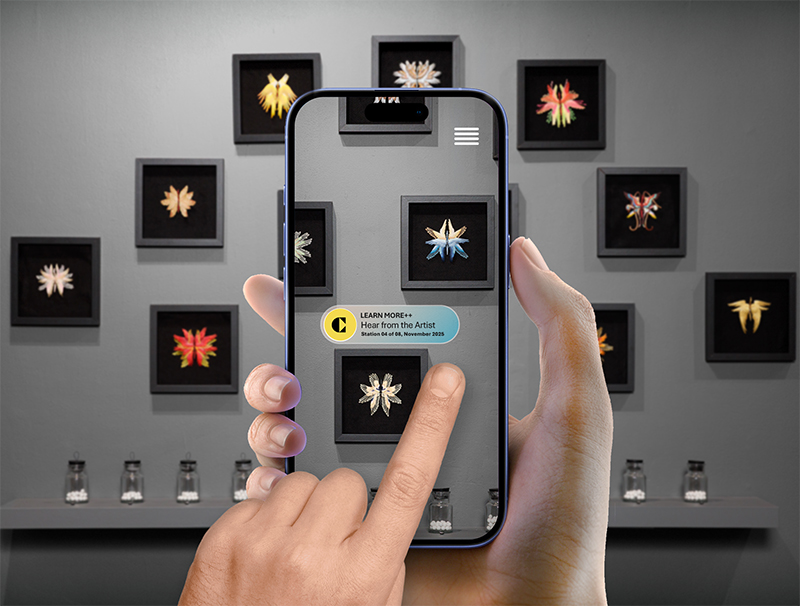
Craft Contemporary approached digital carefully. As an institution centered on the tactile nature of craft, the goal was never to replace the in-room experience, but to extend it—thoughtfully and without disruption. Project Sondr set out to do just that.
The work began with defining a broader digital experience strategy. At its core was a simple principle: digital should act as an augmentation layer, enhancing access, context, and engagement while preserving the integrity of the physical work.
This meant designing for the full visitor journey—before, during, and after a visit—while ensuring that anything introduced on-site felt natural within the space, not imposed on it.
This mobile platform, Project Sondr, emerged as a direct expression of that strategy.
Deployed within the museum, it allows visitors to access contextual information tied to specific works and locations throughout the space. Rather than relying on static materials or fixed installations, the system introduces a flexible layer that can evolve over time.
Accessibility was a primary consideration from the start. The platform supports audio narration, multilingual content, and ADA-aligned features such as captions and subtitles, allowing visitors to engage with the work in ways that match their needs and preferences. Additional functionality allows visitors to comment on works of art in the app which the curatorial team find to be high value.
Behind the scenes, we developed a lightweight content management system that gives the museum full control over this layer. Curators and administrators can create and manage interactive points in real time—adding or updating content without technical support. This shifts the model from a static deployment to an active system the institution can operate and refine continuously.
The platform also provides insight into visitor behavior, allowing the team to understand how people move through the space, what they engage with, and how different forms of content perform. This creates a feedback loop between the experience and future programming decisions.
While the implementation is intentionally understated, the impact is structural. The museum now has a way to extend its exhibitions beyond the physical object—without compromising the experience that makes them valuable in the first place.
This work represents a practical step in a larger transition: applying spatial and interactive systems in a format that is accessible, maintainable, and aligned with how institutions actually operate. This app is in heavy use today and new features are being added every quarter.