
Executive Summary
For over two decades, the trajectory of digital experience design has been defined by a single, evolving challenge: how to translate complex, high-friction systems into intuitive, human-centered narratives. In this case study, we examine the architecture behind WLKR.Learning—an AI-powered K-12 learning platform designed to teach critical thinking, AI literacy, and prompt engineering on the bedrock of core educational standards. Built as the ultimate synthesis of a multidisciplinary career spanning commercial animation for Nickelodeon, Disney Channel, Noggin, and Cartoon Network, AAA video game development for Activision Blizzard (Spider-Man, James Bond), and enterprise-grade digital systems for Microsoft, Cisco, T-Mobile, Amgen, and Booz Allen Hamilton, WLKR.learning represents the realization of a lifelong philosophy: technology should act as an accelerator of human capability, not an obstacle.
Introduction: The Arc of a Creator
Every transformative product is an accumulation of past experiences. Long before modern artificial intelligence transformed the educational landscape, the foundational principles of effective user engagement were forged in the demanding worlds of linear animation and interactive entertainment.
When you spend your formative years crafting visual worlds and character arcs for networks like Nickelodeon, Disney Channel, Noggin, and Cartoon Network, you learn the unyielding rules of audience engagement: capture attention immediately, respect the cognitive load of the viewer, and deliver a great story. Translating those principles from passive media into interactive mechanics at Activision Blizzard—architecting massive, real-time 3D environments and cinematic interactions for marquee titles like Spider-Man and James Bond—demanded a rigorous understanding of spatial design, state management, and user feedback loops.
Yet, building immersive entertainment is only half the equation. Transitioning into enterprise digital strategy and systems architecture for Fortune 500 giants like Microsoft, Cisco, T-Mobile, Amgen, and Booz Allen Hamilton forced a shift toward scale, security, compliance, accessibility (ADA/WCAG), and measurable real-world utility.
When the opportunity arose to conceptualize and build WLKR.learning, it wasn’t a pivot into a new domain—it was the inevitable convergence of these distinct disciplines. How do you combine the character-driven engagement of animation, the systemic interactivity of AAA gaming, and the enterprise reliability of Fortune 500 digital platforms to solve one of the most critical challenges of our time? You build an AI-native learning platform for the next generation.
The Problem Space: Bridging the Generational AI Literacy Gap
We are living through a profound technological shift. Artificial intelligence has permeated every facet of professional and daily life, yet our educational frameworks remain largely tethered to 20th-century paradigms. Students in grades 3 through 8 are digital natives, but they are predominantly consumers of technology rather than architects of it.
Without foundational training in critical thinking, algorithmic literacy, and prompt engineering, students risk becoming passive recipients of automated outputs rather than discerning evaluators of information. Traditional educational software often treats AI as either a dangerous distraction to be banned or a simplistic gimmick.
WLKR.learning was conceived to solve this exact structural failure. The core mandate was clear:
- Align with Rigor: Ground every learning module firmly on established core curriculum standards.
- Humanize the Interface: Introduce a relatable, trustworthy AI companion character (ECKO) to guide students through complex cognitive challenges.
- Foster Active Inquiry: Move away from rote memorization toward scaffolded prompt engineering and analytical problem-solving.
The Architectural Blueprint: Drawing From Three Eras of Design
Phase 1: Character-Driven Engagement (The Animation & Gaming Heritage)
In early education, engagement is everything. If a platform fails to capture a child’s imagination within the first thirty seconds, pedagogical efficacy is irrelevant. Drawing directly from years of experience in character animation (Nickelodeon, Disney Channel, Noggin, Cartoon Network) and AAA game design (Activision Blizzard), the WLKR.learning team approached platform design through a narrative lens.
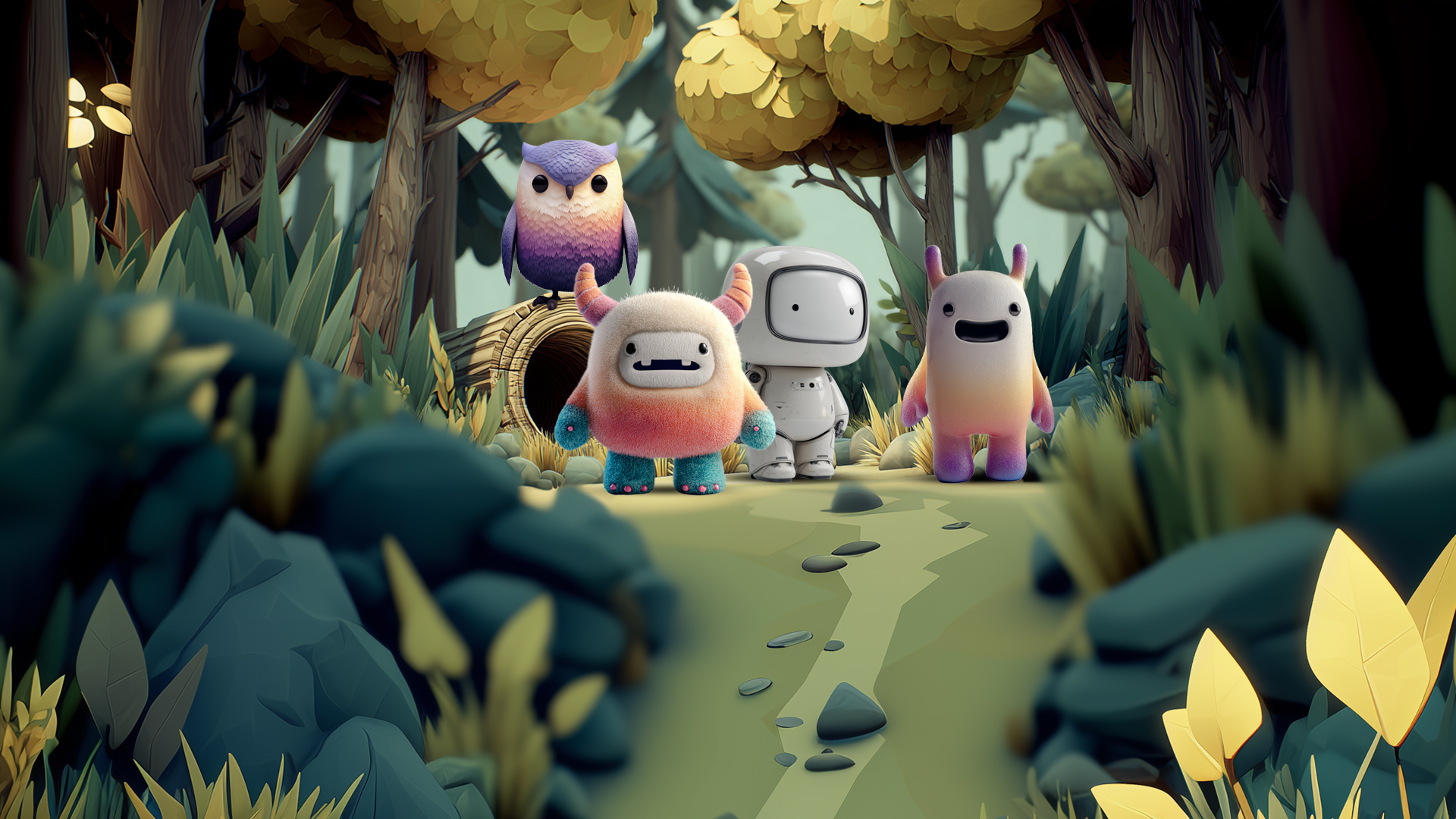
Instead of presenting dry, static multiple-choice questionnaires, WLKR.learning leverages ECKO, an interactive AI companion character designed with the empathetic visual pacing and responsive feedback loops native to high-end character animation. Low-poly 3D asset pipelines, real-time blend shapes, and conversational mechanics ensure that the student feels as though they are collaborating with a peer rather than being interrogated by software. This reduces cognitive anxiety and fosters a safe environment for trial, error, and deep critical inquiry.
Phase 2: Systemic Scalability & Enterprise Reliability (The Fortune 500 Heritage)
An educational platform intended for deployment across diverse school districts cannot rely on fragile prototypes. It requires the robust, scalable architecture perfected while building digital ecosystems, spatial platforms, and enterprise applications for brands like Microsoft, Cisco, T-Mobile, and Booz Allen Hamilton.
Through disciplined systems architecture, WLKR.learning was engineered to ensure:
- Zero-Latency Interactions: Seamless real-time AI generation optimized for lightweight browser environments.
- Strict Privacy & Compliance: Adherence to institutional data governance standards, protecting young learners while complying with educational privacy regulations.
- Modular Scalability: A flexible curriculum backend that allows educators and content creators to map custom modules directly against state and national core standards.
Phase 3: Content Without Obstacles (UX/UI Philosophy)
Informed by decades of agency work at Existent Agency, WLKR.learning adheres strictly to an architectural philosophy of Content Without Obstacles. Every interface element is tested for universal accessibility (WCAG 2.2 standards), ensuring that students with diverse learning styles, visual impairments, or motor differences can navigate the platform fluidly.
Implementation & Impact: Bringing WLKR.learning to Life
The development of WLKR.learning followed a rigorous, multi-phase product lifecycle:
- Discovery & Pedagogical Mapping: Partnering with educators and curriculum specialists to define the exact intersection between foundational core standards and emergent AI competencies.
- Prototyping & Character Rigging: Utilizing modern 3D asset pipelines (Unity/Blender) and natural language processing layers to bring ECKO to life with fluid motion and contextual responsiveness.
- Deployment & Pilot Testing: Launching controlled rollout phases in simulated K-12 environments, measuring student retention, engagement duration, and qualitative shifts in critical thinking aptitude.
The results of this synthesis have redefined what a micro-agency-backed EdTech platform can achieve. By treating software development as an art form backed by rigorous systems engineering, WLKR.learning successfully transforms abstract AI concepts into tangible, joyful learning milestones.
Conclusion: The Ultimate Culmination
Career arcs rarely form a straight line; instead, they spiral upward, connecting seemingly disparate dots across decades of creative evolution. From sketching characters for children’s television networks to optimizing complex enterprise systems and building the next generation of AI-driven educational sandboxes, every project has served as preparation for this work.
WLKR.learning stands as proof that when you combine the soul of an animator, the systems-thinking of a veteran game designer, and the scalable rigor of an enterprise technologist, you don’t just build software—you build tools that empower the human mind.